Integrated CRM + ERP: Your Business’s New Power Duo

In today’s fast-paced digital landscape, data is the new fuel—and disconnected systems are the biggest roadblocks. Most businesses juggle a CRM (Customer Relationship Management) for sales and customers, and an ERP (Enterprise Resource Planning) for finance, inventory, and operations. But what happens when these two worlds merge? An Integrated CRM + ERP system becomes a true power duo—unifying your front-end and back-end operations, bridging gaps between teams, and delivering 360° visibility across the entire business.

What Is an Integrated CRM + ERP System?

An integrated CRM + ERP connects customer-facing processes (like leads, sales, and service) with back-office operations (like accounting, inventory, HR, and logistics). Instead of working in silos, both systems share data in real-time.

For example:

  • When a sales order is confirmed in CRM, it automatically triggers invoice creation and stock deduction in ERP.
  • When an item is out of stock in ERP, the CRM instantly alerts sales reps to avoid over-committing.

This seamless flow ensures zero manual duplication, faster operations, and better customer experiences.
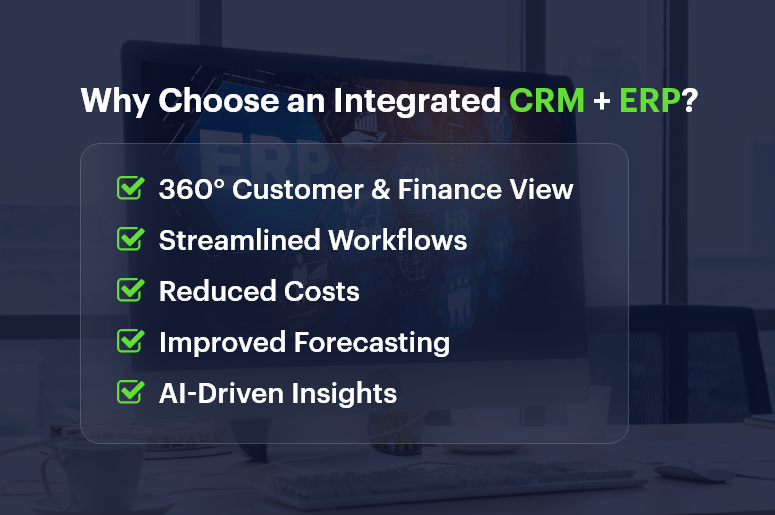
Why Choose an Integrated CRM + ERP

Why Businesses Are Embracing the CRM-ERP Integration Trend

Organizations today demand speed, accuracy, and insight. Managing isolated tools creates inefficiencies like:

  • Duplicate data entries
  • Delayed communication between departments
  • Inaccurate forecasts
  • Missed upsell opportunities

An integrated system breaks these barriers, enabling everyone—from the sales floor to the finance desk—to work from a single source of truth.

Top Benefits of an Integrated CRM + ERP

1. 360° Business Visibility

Gain complete visibility into every customer and transaction. From lead to ledger, every step is traceable—making decisions faster and data-driven.

2. Improved Forecasting

Unified data enables accurate demand forecasting, helping you plan production, procurement, and sales strategies more effectively.

3. Enhanced Collaboration

Sales, support, accounts, and inventory teams collaborate effortlessly. When departments share real-time data, silos disappear.

4. Automated Workflows

No more jumping between platforms. Integrated workflows automatically update orders, invoices, and inventory, saving time and reducing errors.

5. Better Customer Experience

Instant access to customer orders, payment history, and delivery status empowers your team to serve faster and smarter.

6. Reduced Costs

Integration eliminates redundant tools and manual data entry, reducing administrative overhead and operational costs.

How CRM + ERP Integration Works

Integration can be achieved through APIs, middleware, or native connectors between systems.

Here’s how it typically flows:
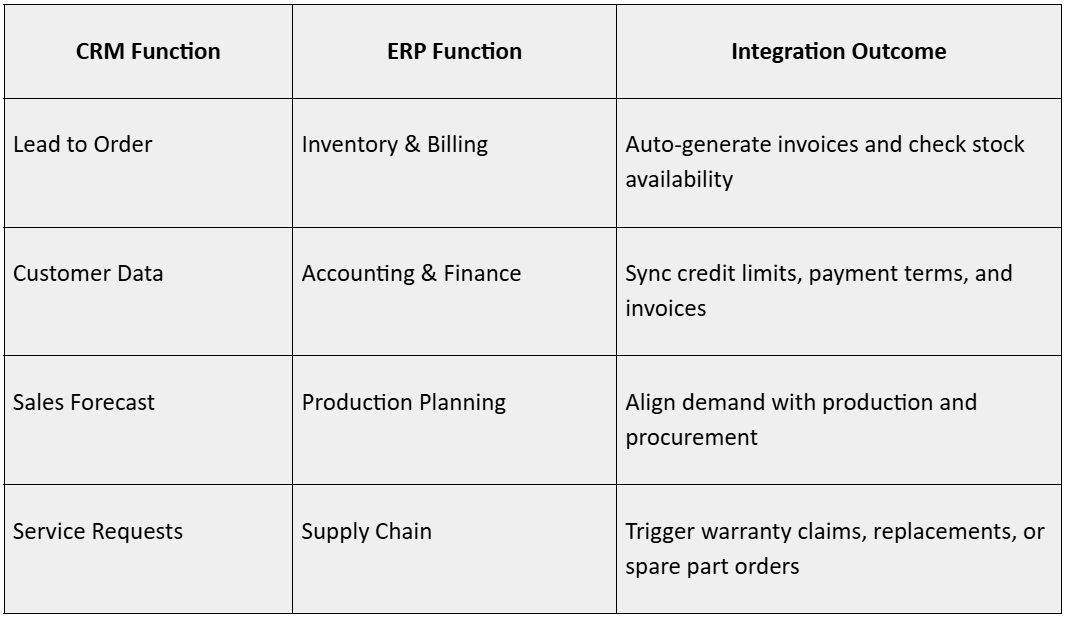
CRM + ERP Evolution

Modern SaaS platforms like CrmLeaf offer built-in integration modules—ensuring real-time synchronization and minimal IT effort.

Industries That Benefit the Most

While every business can gain from integration, it’s especially powerful for:

  • Manufacturing: Aligns production with demand forecasts.
  • Retail & eCommerce: Syncs orders, stock, and fulfillment.
  • Solar & Construction: Connects site operations, inventory, and billing.
  • Service-based businesses: Streamlines invoicing and project tracking.
  • Government & NGOs: Ensures compliance, reporting, and transparent fund utilization.

How to Implement an Integrated CRM + ERP

  • Define Clear Objectives: Identify pain points—manual data entry, slow approvals, or reporting lags.
  • Choose the Right Platform: Pick solutions like CrmLeaf that natively integrate with ERP or support APIs.
  • Plan Data Mapping: Align customer, product, and financial fields across both systems.
  • Test Workflows: Run pilot integrations for order-to-cash and procure-to-pay cycles.
  • Train Teams: Ensure all users understand the integrated workflow.
  • Monitor & Optimize: Use analytics to refine processes and improve performance.

Future of CRM + ERP Integration: AI and Predictive Insights

AI-powered integrations are pushing this synergy further. With machine learning and automation, businesses can now:

  • Predict customer churn
  • Recommend upsell/cross-sell opportunities
  • Automate invoice matching and reconciliation
  • Forecast material needs or sales demand
  • Get real-time alerts for financial or supply chain risks

This means your CRM + ERP doesn’t just record history—it predicts the future.

Key Takeaways

  • CRM + ERP integration bridges your business front and back ends.
  • It delivers unified data, improved collaboration, and faster decisions.
  • With AI, it becomes even smarter—turning insights into instant action.

Conclusion: One System, One Vision

An integrated CRM + ERP is more than a tech upgrade—it’s a strategic transformation. It connects people, processes, and profits into one cohesive ecosystem. Whether you’re managing customer relationships, finances, or compliance, integration ensures every part of your business works in harmony.

If you’re ready to replace silos with synergy, explore how platforms like CrmLeaf ERP can make your business truly connected.

10 FAQs About Integrated CRM + ERP

1. What is the main purpose of integrating CRM and ERP?

To unify sales, finance, and operations under one platform for real-time visibility and efficiency.

2. Does integration require a new system?

Not necessarily. Many CRMs and ERPs can be integrated using APIs or middleware.

3. How does integration improve customer service?

Teams can access order, billing, and service data instantly—reducing response time.

4. Can small businesses benefit from this integration?

Yes, even SMEs gain efficiency and cost savings with integrated workflows.

5. Is CRM + ERP integration cloud-based?

Most modern solutions are cloud-native or hybrid, enabling real-time data sync.

6. How long does integration take?

Depending on system complexity, it can take from a few weeks to a few months.

7. Does it support mobile access?

Yes, leading platforms offer mobile dashboards for CRM and ERP functions.

8. Can I customize workflows?

Absolutely. Integration supports custom fields, triggers, and process automations.

9. How secure is data sharing between CRM and ERP?

Encryption, role-based access, and audit logs ensure enterprise-grade security.

10. What’s the ROI of CRM + ERP integration?

Businesses often see faster invoicing, reduced manual work, and 15–30% productivity gains.

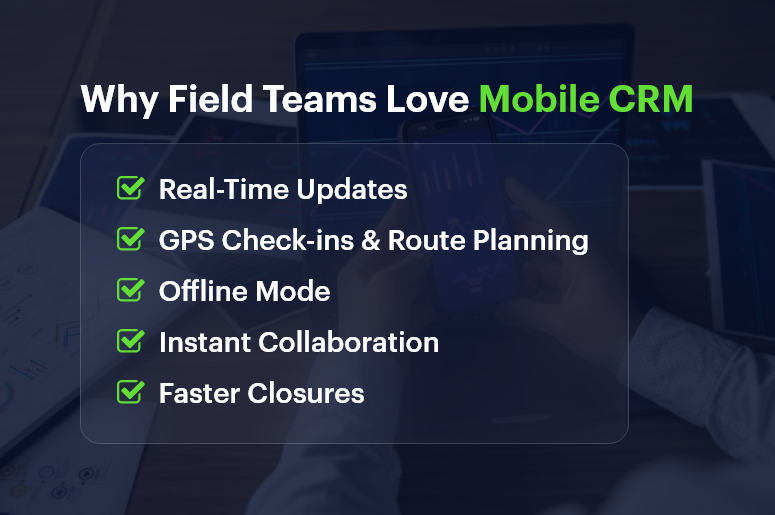
The Rise of Mobile CRM: Why Field Teams Love It?

There was a time when customer relationship management (CRM) tools were used only in offices—by managers updating deals, or support teams logging interactions. But today, that’s changed completely. With businesses operating across multiple cities, remote teams on the go, and customer touchpoints happening everywhere, Mobile CRM has become the heartbeat of modern sales and service operations.

In a world where speed, data accuracy, and instant communication define success, mobile CRMs empower field teams to close deals faster, provide better service, and stay connected in real time—no matter where they are.

What Is a Mobile CRM?

A Mobile CRM is a cloud-based application that allows users to access customer data, manage tasks, log calls, update deals, and track leads directly from their smartphone or tablet.

It’s essentially the full power of your desktop CRM—repackaged into a mobile app that moves with your team.

Core Features

  • Contact & Deal Management: Access customer profiles and deal stages on the go.
  • GPS Check-ins: Log customer visits and verify field activity automatically.
  • Offline Access: Work even without internet—data syncs when you reconnect.
  • Real-Time Notifications: Get instant updates on new leads, tasks, and opportunities.
  • Task & Route Planning: Schedule visits and plan the shortest travel routes efficiently.

Payroll Compliance Made Simple

Why Mobile CRM Is a Game-Changer for Field Teams

Field sales and service professionals spend more time on the road than at desks. For them, switching between spreadsheets, WhatsApp messages, and phone notes is a recipe for chaos.

Mobile enabled CRM consolidates everything into one simple app—making field operations faster, smarter, and more accountable.

Let’s explore why field teams across industries are embracing Mobile CRM.

1. Real-Time Customer Updates

With a mobile CRM, every update is instant.

Sales reps can:

  • Update deal status immediately after a meeting
  • Record customer feedback or objections in real time
  • Share on-ground insights with their managers instantly

This eliminates manual end-of-day reporting and ensures everyone stays in sync—from the field rep to the regional manager.

2. Smarter Route and Visit Planning

A modern mobile CRM integrates with GPS to help plan customer visits efficiently and geographically.

Sales teams can:

  • View leads on a map
  • Optimize travel routes
  • Log visits automatically through geo-tagging

The result? Less time on the road, more time selling.

3. Offline Access, Zero Connectivity Issues

Field executives often work in remote areas where the network is unreliable. Mobile CRMs like CrmLeaf solve this by allowing data entry offline. Once connectivity is restored, everything syncs automatically to the cloud. No more lost notes, delayed updates, or missed opportunities.

4. Instant Collaboration Between Teams

When field teams log updates instantly, back-office teams can act faster—assigning quotes, processing requests, or approving orders in real time. This bridges the communication gap between sales, service, and operations, improving turnaround time and customer satisfaction.

5. Increased Productivity and Accountability

With call logs, GPS check-ins, and visit reports, managers can track productivity transparently. Field reps, on the other hand, benefit from structured task lists, reminders, and notifications that keep them focused.

Everyone wins:

  • Managers get clear visibility
  • Reps get simplified workflows
  • Customers get faster service

6. Faster Decision-Making Through Real-Time Insights

A mobile CRM provides analytics dashboards right on your phone.

You can:

  • Check daily lead performance
  • Track deal conversion trends
  • View revenue forecasts on the go

It empowers both reps and managers to make data-backed decisions—without waiting for weekly reports or office logins.

7. Better Customer Experience

The best part? Mobile CRMs make customer interactions more personal and informed.

When a rep meets a client, they can instantly view:

  • Past interactions
  • Purchase history
  • Support tickets or invoices

This enables personalized conversations, stronger relationships, and faster resolutions.

Customers don’t need to repeat information—they get a seamless, professional experience.

Industries Benefiting Most from Mobile CRM

Mobile CRM adoption is rising across multiple industries that depend on distributed, field-based teams, such as:

  • Construction & Real Estate: Track site visits, client approvals, and contractor follow-ups.
  • Solar & Energy: Manage installation teams, vendor performance, and AMC schedules.
  • Healthcare & Pharma: Monitor medical reps’ visits and track hospital leads.
  • Automotive: Manage dealer networks and after-sales service calls.
  • Finance & NBFCs: Enable on-ground loan officers and field collectors.

Across all these sectors, Mobile CRM isn’t just a convenience — it’s a competitive advantage.

How CrmLeaf Simplifies Field Operations

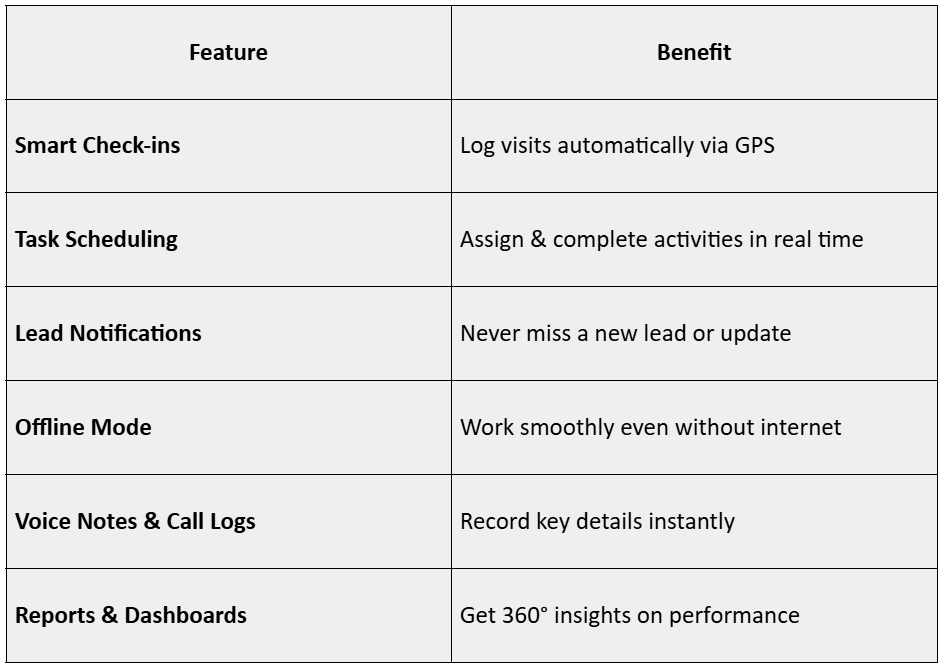
CrmLeaf’s Mobile CRM is built for high-performing field and remote teams. Here’s how it transforms daily workflows:

The rise of mobile CRM

With CrmLeaf Mobile, field teams can spend less time updating systems and more time closing deals.

Why Field Teams Love Mobile CRM

Here’s what makes field professionals truly love mobile CRMs like CrmLeaf:

“I don’t have to call my manager every time I finish a visit.”

“My check-ins are automatic—I just focus on the customer.”

“I can update deals in the cab, right after meetings.”

“I see my targets, performance, and tasks on one screen.”

“No need for end-of-day reports. It’s all synced instantly.”

It’s freedom, visibility, and efficiency rolled into one pocket-sized powerhouse.

Conclusion

The rise of Mobile CRM marks a major shift in how sales and service teams operate. It’s not just a smaller version of your desktop CRM — it’s a real-time, always-on command center for every field professional.

As businesses go hybrid and customer expectations rise, CrmLeaf’s mobile-first CRM ensures your teams stay connected, productive, and ahead of every opportunity — wherever they are.

Frequently Asked Questions

1. What is a Mobile CRM?

A mobile CRM is a cloud-based CRM system accessible from smartphones and tablets, enabling users to manage leads, customers, and tasks on the go.

2. Who benefits most from Mobile CRM?

Field sales, service technicians, delivery teams, and remote employees benefit the most.

3. Can Mobile CRM work offline?

Yes, most mobile CRMs — including CrmLeaf — offer offline access that syncs once online.

4. How does Mobile CRM increase productivity?

It reduces manual reporting, automates check-ins, and ensures real-time visibility.

5. Is Mobile CRM secure?

Yes. Data is encrypted and stored securely in the cloud with user-level access controls.

6. Can I integrate Mobile CRM with other apps?

Absolutely. It integrates with email, ERP, payroll, and marketing tools.

7. How does GPS tracking help?

It verifies on-field visits, optimizes routes, and ensures transparency in field activity.

8. What’s the difference between CRM and Mobile CRM?

Traditional CRM is desktop-based; Mobile CRM is accessible anywhere and built for mobility.

9. Do managers also use Mobile CRM?

Yes. Managers use it to monitor field performance, track pipelines, and approve actions remotely.

10. Why is Mobile CRM critical for modern sales?

Because it enables instant updates, data accuracy, and faster decision-making—critical in fast-moving markets.

Why Collaborative CRMs Are the Future of Teamwork?

In fast-moving teams, the gap between “who knows the customer” and “who is talking to the customer” can make or break growth. A Collaborative CRM closes that gap. It turns scattered conversations, siloed notes, and disconnected tools into a single, shared workspace where marketing, sales, success, finance, and support actually work together—in real time—around each account.

Below, we unpack what a collaborative CRM is, why it matters now, which features truly move the needle, how to roll it out successfully, and how to measure ROI.

What is a Collaborative CRM?

A Collaborative CRM is a customer relationship platform designed primarily for teamwork. Beyond recording contacts and deals, it centralizes conversations, files, tasks, and context so every stakeholder sees the same customer 360. It reduces “Who owns this?” confusion, streamlines handoffs across teams, and keeps decisions visible.

Key idea: Treat the CRM as a shared operating system for customer work—not just a pipeline tracker.

The Future of Teamwork Is Collaborative CRM

Why Collaborative > “Classic” CRM

Traditional CRMs focused on individual rep productivity and reporting. Today, buying journeys are multi-threaded, post-sale relationships drive revenue, and messages flow across email, chat, socials, calls, and portals. Therefore, teams need:

  • One conversation history across channels, not fifteen disconnected threads.
  • Shared accountability, not one person’s inbox.
  • Faster handoffs from marketing → sales → onboarding → support → finance.
  • Collective memory (notes, decisions, files) that survives team changes.

In short: a Collaborative CRM mirrors how modern teams actually deliver value.

Core Benefits of a Collaborative CRM

1.Fewer dropped balls
Shared visibility + assignment rules mean every inquiry has an owner, a due date, and a next step.

2. Shorter response and cycle times
Teams collaborate in-context (inside the record), so follow-ups happen faster and deals move sooner.

3. Consistent customer experience
Everyone sees the same timeline, preferences, SLAs, and commitments—so replies stay on-brand.

4. Better cross-sell and expansion
Success and support insights feed back to sales. Opportunities appear earlier and feel natural.

5. Higher quality forecasting and planning
With richer activity data from more teams, forecasts become realistic, not optimistic.

6. Lower tool sprawl and context switching
Shared inboxes, notes, docs, and tasks live beside accounts. Fewer tabs; fewer mistakes.

Must-Have Features (That Truly Drive Collaboration)

1. Shared Inbox & Omnichannel Timeline
Email, chat, WhatsApp, phone logs, and social DMs roll into a single threaded history per contact/company.

2. Mentioning, comments, and tasking inside records
@mention teammates, assign tasks, set due dates, and attach files—all without leaving the CRM.

3. Playbooks & Guided handoffs
Template steps for common journeys (e.g., “Inbound Demo → Discovery → Proposal → Security Review → Onboarding”).

4. Customer notes that auto-link to records
Meeting notes sync to the right account and opportunity—no copy/paste, no lost context.

5. Role-based visibility & field-level permissions
Finance can see invoices; engineering can see escalations; sales can’t edit SLAs—clean and secure.

6. Embedded docs and knowledge
Proposals, MSA templates, onboarding checklists, and internal KB articles available in one click.

7. Automation with a human loop
Auto-assign, auto-notify, auto-create tasks—but allow reviewers to intervene when stakes are high.

8. Open APIs & integrations
Connect your support desk, billing, e-signature, marketing automation, calendars, and data warehouse.

Collaboration Use Cases (By Team)

1. Marketing → Sales

  • MQLs land with campaign context, last touch, and content consumed.
  • Sales leaves structured feedback; marketing tunes targeting and offers.

2. Sales → Solutions/Legal/Finance

  • Security questionnaires, pricing approvals, and redlines tracked as tasks against the opportunity.
  • Stakeholders get notified only when their step is due.

3. Sales/Success → Support

  • “At-risk” flags and VIP tags push to support, so the tone and SLA match the relationship.
  • Support escalations loop back to the CSM with next steps.

4. Success → Product

  • Feature requests tie to ARR and account segments, helping product prioritize roadmaps with revenue impact.

Implementation Blueprint (90 Days)

#1 Phase: Foundations (Weeks 1–3)

  • Map key objects (Accounts, Contacts, Deals, Tickets, Subscriptions).
  • Define shared stages and SLAs.
  • Connect email/calendar, chat, help desk, billing, and e-signature.
  • Set roles, permissions, and required fields to ensure clean data.

#2 Phase: Collaborative Workflows (Weeks 4–6)

  • Launch shared inbox for inbound sales/support.
  • Create handoff playbooks (e.g., “Closed-Won → Onboarding”).
  • Configure notifications, task queues, and routing rules.
  • Pilot with one cross-functional pod; refine based on feedback.

#3 Phase: Adoption & Enablement (Weeks 7–10)

  • Run role-based training with real records.
  • Establish “source of truth” norms (where notes live, when to @mention, what to log).
  • Publish a short internal “Collaboration Contract” (see below).

#4 Phase: Measure & Optimize (Weeks 11–13)

  • Track baseline vs. current KPIs (see next section).
  • Tweak automations, templates, and fields.
  • Celebrate quick wins; share before/after anecdotes.

Your Internal “Collaboration Contract” (Copy/Paste)

  • Log every customer-facing decision in the CRM record.
  • Use @mentions instead of private DMs for account-related asks.
  • Keep all files linked to the account/opportunity—not in personal drives.
  • Use playbooks; don’t reinvent steps.
  • Close the loop: every task needs an owner and a due date.

What to Measure (to Prove ROI)

  • Time to First Response (lead & support)
  • Lead → Opportunity Conversion Rate (by source and segment)
  • Sales Cycle Length (days from first meeting to close)
  • Onboarding Time to First Value (days to go-live/adoption)
  • Renewal & Expansion Rate (logos and net revenue retention)
  • Ticket Resolution Time & Reopen Rate
  • Notes/Tasks per Opportunity (as a proxy for collaboration quality)
  • Forecast Accuracy (variance % vs. actual)

Track these monthly; review them cross-functionally, not just in sales meetings.

Collaborative CRM vs. Operational & Analytical CRM

  • Operational CRM optimizes day-to-day processes (pipelines, case management).
  • Analytical CRM aggregates data for reporting and modeling.
  • Collaborative CRM focuses on people working together at the moment.

In practice, your platform should cover all three—but prioritize collaboration features that change daily behavior.

Security, Compliance, and Governance (Don’t Skip This)

  • Enforce least-privilege access and field-level controls.
  • Set data retention and audit trails for regulated markets.
  • Use single sign-on and MFA.
  • Implement PII masking where appropriate.
  • Regularly review integration scopes and API keys.

Strong governance builds trust—and adoption follows trust.

Common Pitfalls (and How to Avoid Them)

  • Tool sprawl remains if you don’t consolidate workflows. Start with the top three channels and expand.
  • Private side-channels (email/DMs) persist. Make collaboration inside the CRM the cultural default.
  • Over-automation backfires. Keep humans in the loop for approvals and exceptions.
  • Messy fields kill reports. Use required fields, validation, and sunset unused picklists quarterly.
  • One-and-done training fails. Offer short, role-based refreshers and a living internal KB.

The Bottom Line

Customer work is a team sport. A Collaborative CRM gives your organization a shared field, common playbook, and real-time scoreboard. It reduces friction, speeds outcomes, and delivers a consistent experience across the entire lifecycle—from first touch to renewal.

If you’re choosing a platform, prioritize shared context, handoff automation, role-based visibility, and open integrations. Then reinforce the culture: log in public, ask in public, decide in public. That’s how collaboration compounds—and how revenue, retention, and reputation follow.

FAQs

1. How is a collaborative CRM different from a traditional CRM?
It centers on shared work—conversations, tasks, and handoffs—rather than only individual pipelines and reports.

2. Do we need a shared inbox?
Yes. It’s the backbone of transparent ownership, faster responses, and better SLAs.

3. Will it replace our help desk or marketing tools?
Not necessarily. It should integrate deeply so context flows both ways.

4. What about data quality?
Use required fields, validation rules, and quarterly field hygiene to keep reports trustworthy.

5. How do we drive adoption?
Publish a collaboration contract, run role-based training, and make in-record comments/tasks the norm.

6. Is a collaborative CRM right for small teams?
Absolutely. Even five people benefit from shared context and fewer handoff mistakes.

7. Which integrations matter most?
Email/calendar, chat, support desk, billing, e-signature, product analytics, and data warehouse.

8. Can we measure collaboration?
Track notes per record, @mentions, response times, and cycle times. Improvement shows real collaboration.

9. How long does implementation take?
Many teams see value in 30–90 days with a phased rollout and a pilot pod.

10. What about security and compliance?
Enforce RBAC, MFA, audit logs, and data-retention policies. Integrate SSO and limit API scopes.

How a Client Portal Builds Trust & Transparency?

In today’s fast-paced business world, trust and transparency are non-negotiable. As small and mid-sized businesses grow, building strong relationships with customers becomes more crucial than ever. But how can you ensure that clients feel confident in your services? The answer lies in leveraging client portals. A portal is a secure online space that enables businesses to share important data, track progress, and foster transparency with customers in real time.

This blog post will explore how integrating a portal within your CRM system can transform your customer relationships, boost collaboration, and build lasting trust. If you’re a business owner, operations manager, or HR professional looking to streamline communication and improve client relationships, read on.

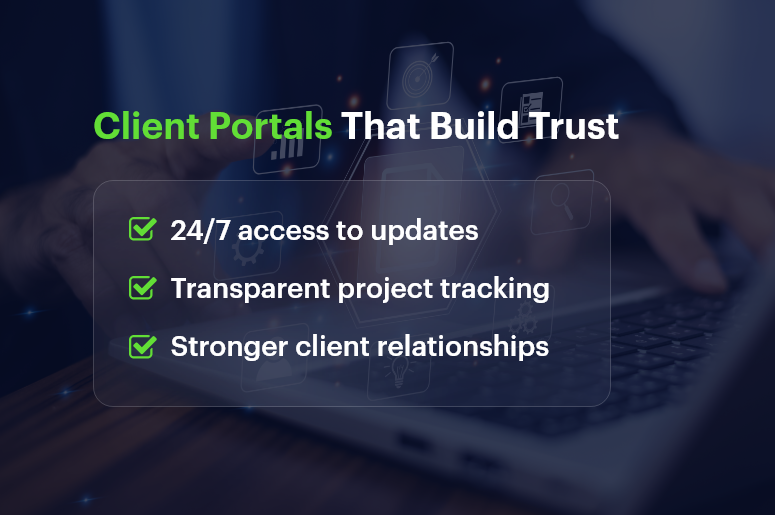
Client Portals That Build Trust

Why a Portal Matters for Growing Businesses

In a world where customer expectations are higher than ever, trust-building is essential for long-term success.

Businesses today are expected to be more transparent and accessible, especially when handling sensitive information, contracts, or project updates. Here’s why a portal matters:

  • Instant Access to Information: Clients expect real-time access to important updates, reports, and project statuses. A portal ensures that they can easily access the information they need without having to reach out for it.
  • Improved Communication: Transparency fosters trust. A portal allows clients to see the progress of their projects, track any issues, and even communicate directly with team members. This constant flow of information builds stronger relationships.
  • Data Security: In an age of increasing cybersecurity concerns, having a portal guarantees that sensitive information is shared in a secure, private environment. Your clients will appreciate knowing that their data is protected.

Best Practices for Building Trust and Transparency with a Portal

1. Provide Real-Time Updates
The power of a client portal lies in its ability to provide customers with real-time access to key information. Whether you’re updating them on project progress, financial reports, or deliverable timelines, transparency should be a top priority.

Best Practice Tip: Always make sure that updates are timely and accurate. Use the portal to send automated notifications and reminders about important dates or changes.

2. Implement Robust Communication Features
Clear communication is key to trust. A portal should allow for seamless two-way communication. This means not just allowing clients to view information but also giving them the opportunity to ask questions, provide feedback, or even request changes.

Best Practice Tip: Integrate messaging, chat support, or even task-specific commenting options in the client portal. This will ensure that clients feel heard and engaged.

3. Ensure Easy Access to Documentation
Clients often need access to contracts, invoices, project deliverables, and other key documents. By integrating these resources into your portal, you not only save time but also reduce the risk of miscommunication or misplaced information.

Best Practice Tip: Make documents easy to find and download. Organize them into folders or categories for quick access.

4. Offer Customizable Dashboards
A client portal can be a one-stop shop for all your client’s needs, but it’s important to offer customization options. Some clients may want to see specific reports, while others might focus on different metrics. A customizable dashboard enhances the user experience, making it easy for clients to monitor what’s important to them.

Best Practice Tip: Allow clients to adjust their views based on their preferences. This personalized experience will further build their trust.

5. Demonstrate Transparency through Analytics
Transparency isn’t just about sharing information; it’s about offering clients insights into how their data is used, tracked, and managed. By showing clear, actionable analytics in your portal, you build trust through the data itself.

Best Practice Tip: Include features like progress tracking, goal achievement percentages, and performance metrics within the portal. This level of transparency is not only expected but also appreciated by clients.

Customer Success Story

For example, a growing marketing agency, used CRMLeaf’s client portal to streamline client communications.

By integrating automated reporting and progress updates, the agency was able to increase client satisfaction by 25% within six months. Clients appreciated the transparency in tracking their projects, which led to a 30% increase in repeat business.

Key Takeaways

  • A client portal enhances trust by providing real-time access to information and data.
  • Communication is central to transparency. Implement messaging or chat features in your portal to keep clients informed.
  • Security is paramount. Make sure your portal offers robust data protection to reassure clients that their information is safe.
  • Customizable dashboards and analytics further foster trust by letting clients tailor the portal experience to their needs.

By integrating a portal into your CRM platform, you create a seamless, transparent experience that builds long-term relationships based on trust.

Closing Thoughts

Transparency and trust are at the core of every successful business relationship. A client portal is one of the most effective tools you can leverage to strengthen these bonds. By offering real-time updates, secure communication channels, and easy access to important information, you show your clients that you’re committed to their success.

Ready to see how CRMLeaf can help you build stronger, more transparent relationships with your clients? Start a free trial today and experience the difference.

HR Compliance: Avoid These 5 Costly Payroll Mistakes

Did you know that over 33% of small businesses get fined each year due to payroll errors? These aren’t just bookkeeping blunders — they’re HR compliance time bombs. Whether it’s misclassifying employees, missing deadlines, or incorrectly filing taxes, even a single mistake can lead to government penalties, employee distrust, and operational delays.

In this blog, we’ll unpack the five most common payroll mistakes that can wreck your HR compliance, especially if you’re still relying on manual or disjointed systems. We’ll also show you how a connected HRMS like CRMLeaf helps eliminate these issues before they cost you time, money, or reputation.

Let’s make sure your business stays compliant, confident, and payroll-error free.

Why Payroll Compliance Matters More Than Ever

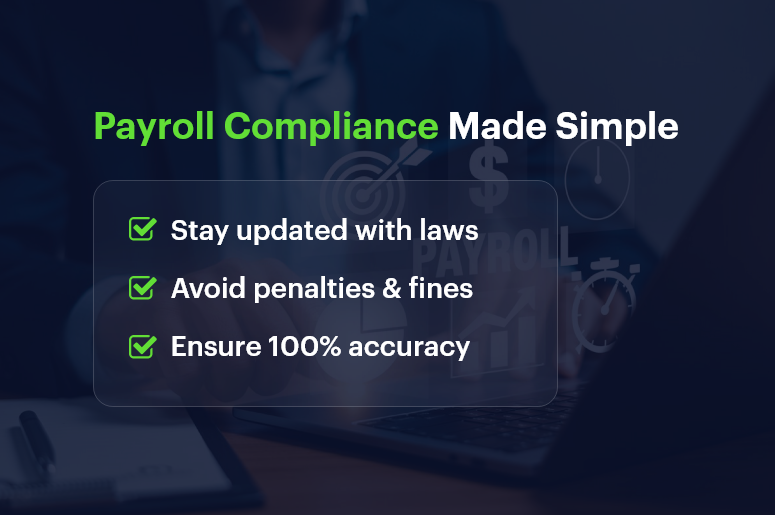
HR compliance isn’t just about avoiding fines — it’s about protecting your people, your brand, and your bottom line. With regulations tightening globally and employees expecting faster, error-free payrolls, companies across all sectors must raise their game.

Let’s look at a few real-world scenarios:

  • Retail chains often struggle with employee classification, especially with part-timers, freelancers, or interns.
  • Manufacturing units may unintentionally breach labor law limits on overtime if systems don’t track it well.
  • Startups in tech may underpay or delay benefits during rapid hiring — leaving room for payroll compliance violations.

No matter your industry, if you don’t build a compliant payroll workflow into your HR systems, your risk of penalty — and employee dissatisfaction — soars. And as your company grows, so do these risks.

With a smart, integrated HRMS system like CRMLeaf, you automate compliance checkpoints, reduce human error, and stay ready for audits at any time.

Payroll-Compliance-Made-Simple

5 Payroll Mistakes That Can Ruin Your HR Compliance

1. Misclassifying Employees or Contractors

Why It’s a Problem:

Classifying someone as a contractor instead of an employee can help avoid taxes — until it doesn’t. If regulators catch it, expect back taxes, interest, and penalties.

How to Avoid It:

A connected HR + Finance ERP lets you define contract types clearly and apply tax deductions, benefits, and responsibilities accordingly. CRMLeaf helps ensure proper classification through rule-based workflows and smart prompts.

2. Missing or Delaying Payroll Tax Filings

Why It’s a Problem:

Governments are strict about payroll taxes. Late filings or incorrect amounts can cost thousands in interest, not to mention damage to your brand.

How to Avoid It:

Use automated tax filing tools built into CRMLeaf’s payroll module. These trigger reminders, generate reports, and even auto-submit filings — so you never miss a due date again.

3. Inaccurate Time Tracking and Overtime Calculations

Why It’s a Problem:

Miscalculating overtime — or not paying it at all — is one of the top labor law violations. This can escalate quickly into lawsuits or fines from labor boards.

How to Avoid It:

HR software like CRMLeaf integrates time tracking, attendance, and payroll. This ensures that any extra hours logged get automatically reflected in the payroll calculations — keeping you safe and fair.

4. Not Keeping Updated With Compliance Changes

Why It’s a Problem:

Payroll laws change often — be it minimum wage updates, tax slab revisions, or reporting obligations. Not staying current means non-compliance, even if it’s unintentional.

How to Avoid It:

CRMLeaf regularly updates compliance modules to match local and national payroll laws. You also get notifications and templates aligned with the latest rules — keeping your team always one step ahead.

5. Failing to Maintain Payroll Records and Audit Trails

Why It’s a Problem:

If you’re ever audited, you’ll need a clear, accurate payroll history. Manual records are error-prone, and missing information can cost you in legal defense.

How to Avoid It:

CRMLeaf’s cloud-based HR module stores all payroll documents with version history, approval logs, and timestamps. You’ll always have a clean, traceable digital trail for every transaction.

Best Practices to Stay Payroll-Compliant Year-Round

Consistency and automation are the foundation of payroll compliance. Here’s what businesses should focus on:

1. Automate Payroll Workflows

Manual steps increase the risk of missed actions and errors. By setting up end-to-end payroll automation in CRMLeaf, you reduce dependencies on HR staff while increasing accuracy and speed.

2. Use Checklists for Monthly Payroll Runs

Create a monthly compliance checklist that includes tax calculations, statutory deductions, and employee approvals. CRMLeaf lets you digitize and reuse checklists so no step is skipped.

3. Train Your HR and Finance Teams

Even the best system can’t help if the people using it don’t understand compliance protocols. Conduct quarterly training sessions using CRMLeaf’s built-in LMS or link to an HR learning platform.

4. Run Compliance Audits Quarterly

A small internal audit helps spot issues early. With CRMLeaf’s built-in analytics, you can generate compliance reports to track accuracy, deductions, and pay discrepancies.

5. Keep Everything Centralized

Avoid data silos. Integrate your payroll, HR, and finance functions under a single HRMS system. This centralization reduces duplication, speeds up approvals, and ensures real-time updates across the board.

Customer Success

For example, Nimbus Textiles, a mid-sized manufacturing company, used CRMLeaf Payroll Automation to reduce payroll processing time by 60% and cut tax filing errors to zero. By integrating attendance, payroll, and compliance under one platform, they avoided a ₹2,00,000 fine due to late tax filing — and saved 20+ hours monthly.

Key Takeaways & Final Thoughts

Avoiding payroll mistakes is not just about fixing errors — it’s about building trust, scaling safely, and focusing on your growth instead of fearing the next compliance audit.

  • Misclassifications, late filings, and poor time tracking are the biggest threats to HR compliance.
  • A connected HRMS system like CRMLeaf eliminates guesswork with automation, alerts, and clear reporting.
  • Companies that prioritize payroll compliance enjoy smoother operations, fewer disruptions, and stronger employee morale.

Whether you’re in retail, tech, manufacturing, or services, now is the time to move from manual to modern HR practices.

Data Silos Are Killing Your Productivity: Here’s How to Fix Them

In today’s competitive, fast-moving business environment, data silos are quietly sabotaging your productivity. According to Gartner, poor data quality — including siloed data — costs organizations an average of $12.9 million per year. It’s not just about lost revenue; it’s about missed opportunities, duplicated work, and frustrated teams.

Data silos are what happen when different departments hoard information in disconnected systems. Sales uses one tool. HR uses another. Finance has a spreadsheet. Nobody talks, and nothing flows. The result? Poor communication, inconsistent data, and a sluggish, inefficient workflow.

But it doesn’t have to be this way.

This guide will show you how data silos are hurting your business—and more importantly, how to break them down using modern CRM software. By the end, you’ll have clear strategies and tools to eliminate information barriers and unlock real productivity.

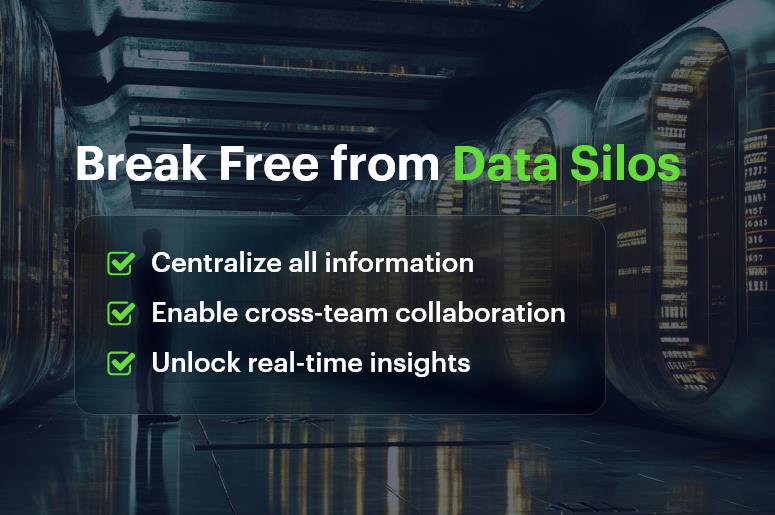
Break Free from Data Silos

Why Data Silos Are a Problem for Growing Businesses

If you’re scaling a team or expanding across departments, data silos become a ticking time bomb. At first, they’re subtle — some missed emails here, a delayed response there. But as your team grows, the cracks widen.

Here’s why data silos are such a problem:

  • They slow decision-making. When teams don’t have access to the same information, decisions are made with outdated or incomplete data.
  • They breed inefficiency. Multiple versions of the same data create confusion, extra work, and duplicated efforts.
  • They block collaboration. Cross-functional teams can’t align when data lives in different places.
  • They damage customer experience. If support doesn’t know what sales promised, or billing isn’t aligned with service delivery, the customer suffers.

Industry Examples

  • Retail: Sales and inventory operate in silos, leading to stockouts or overordering.
  • Healthcare: Patient data is locked in separate systems across departments, delaying treatment.
  • Manufacturing: Supply chain, procurement, and finance use disconnected tools, leading to budget overruns and delays.

In short, data silos aren’t just annoying — they’re costly and risky.

How to Break Down Data Silos: Best Practices That Work

You don’t need to overhaul your entire business to eliminate data silos. Small, strategic steps can have a massive impact — especially when powered by an integrated CRM platform like CRMLeaf.

1. Centralize Your Data

Start by bringing all critical data — customer, project, HR, sales, finance — into one unified system. This ensures that everyone sees the same real-time information.

Quick Tip: Use CRM software that supports multi-departmental integration.
Why it matters: When teams access the same data, you reduce confusion and increase alignment.

2. Standardize Data Entry Across Teams

Inconsistent data entry is a silent killer. Standard fields, dropdowns, and input rules ensure that all departments collect and store data uniformly.

Quick Tip: Build standardized forms within your CRM system for every team — sales, support, HR, etc.
Why it matters: Standardization eliminates duplication and makes data easier to analyze.

3. Automate Workflows Between Departments

Automated triggers help hand off tasks between teams — like notifying finance when a sale is closed or alerting HR when a new hire is added.

Quick Tip: Use your CRM platform to automate recurring, cross-functional workflows.
Why it matters: This reduces manual back-and-forth and eliminates dropped handoffs.

4. Enable Role-Based Access for Transparency & Control

Everyone should see what they need — no more, no less. Role-based permissions help break silos while maintaining data security.

Quick Tip: Set permissions by department or role inside your CRM to maintain data privacy without hiding critical information.
Why it matters: Balanced transparency boosts collaboration without risking sensitive data.

5. Train Teams to Use One Source of Truth

Tool fatigue is real. If your teams are bouncing between 7 apps, they’ll default to what they know. Reinforce the CRM as the single source of truth.

Quick Tip: Offer onboarding and refresher training. Highlight how the CRM improves their daily workflow.
Why it matters: Adoption is key — technology doesn’t break silos, people do.

Customer Success Story: Breaking Silos in Real Time

SkyTech Solutions, a mid-sized IT services firm, struggled with disconnected tools across sales, service, and HR. Sales used spreadsheets. HR used outdated software. Communication was fragmented, and productivity dropped.

By switching to CRMLeaf, they centralized all client, employee, and project data in one place. Automated workflows linked sales to onboarding, while real-time dashboards gave leadership total visibility. In just 4 months, productivity increased by 28%, and internal support ticket resolution improved by 35%.

Here’s how:

  • Unified CRM reduced manual follow-ups by 60%
  • Role-based access ensured secure, department-specific visibility
  • Automated alerts eliminated missed handoffs between teams

Key Takeaways

  • Data silos block visibility, reduce efficiency, and hurt collaboration.
  • Centralizing information through a unified CRM platform boosts productivity and communication.
  • Breaking silos doesn’t require massive change — just smarter, integrated tools and consistent processes.

Data silos are a silent killer of productivity in growing businesses. They fragment information, delay decision-making, and weaken collaboration across departments. But with the right approach, you can eliminate these silos without overhauling your entire operation.

A unified CRM platform like CRMLeaf empowers teams to work from a single source of truth, enabling real-time access to critical data across departments.

By centralizing information, standardizing inputs, automating cross-functional workflows, and implementing role-based access, businesses can drastically improve operational efficiency. Ultimately, breaking down data silos leads to better collaboration, faster decisions, and a measurable boost in productivity.