Boost Efficiency with Sales and Operations Automation

In 2025, over 70% of growing businesses report revenue leakage, delayed decision-making, or customer dissatisfaction due to manual processes and disconnected systems. Sales teams chase leads in one tool, operations track execution in another, and finance reconciles everything in spreadsheets — often days or weeks later. As a result, leadership lacks real-time visibility, teams duplicate effort, and opportunities slip through the cracks. This is precisely where sales and operations automation becomes a strategic necessity rather than a technology upgrade. Automation connects people, processes, and data across the organization, ensuring work flows seamlessly from lead generation to delivery, billing, and reporting.

In this guide, you will learn the top automation processes that directly improve sales performance and operational efficiency, why they matter more than ever in 2025, and how a unified CRM platform like CrmLeaf enables end-to-end automation without complexity. By the end, you will have a practical framework to identify automation opportunities, avoid common mistakes, and drive measurable business outcomes.
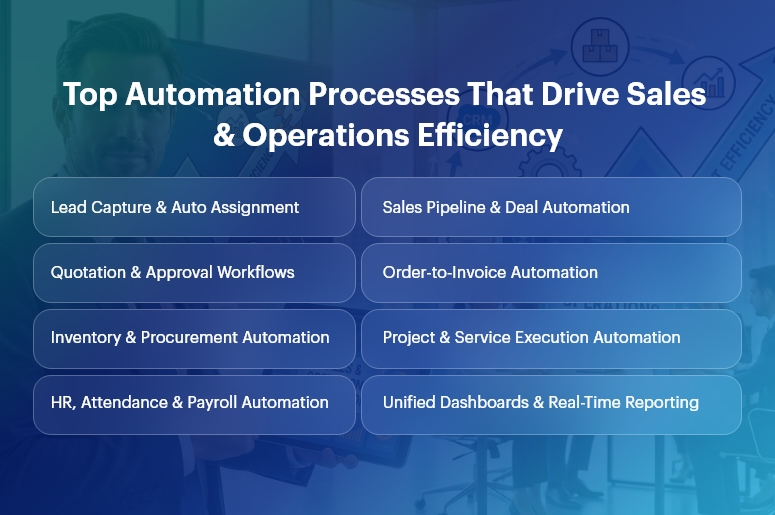
Top Automation Processes That Drive Sales & Operations Efficiency (1)

Business Need & Importance

Today’s small and mid-sized businesses operate in a high-pressure environment defined by shorter sales cycles, rising customer expectations, compliance demands, and margin sensitivity. However, many still rely on manual handoffs, spreadsheets, and siloed applications.

Why manual processes hurt growth

  • Delayed sales follow-ups and approvals reduce conversion rates and increase customer churn.
  • Disconnected operations and finance data lead to inaccurate forecasts and budget overruns.
  • Human-dependent workflows introduce errors, rework, and compliance risks.

This is why sales and operations automation has become mission-critical.

Industry examples

  • Manufacturing: Manual order processing and inventory updates cause production delays and excess stock. Automation synchronizes CRM orders with MRP, inventory, and invoicing.
  • Retail & Distribution: Disconnected sales, warehouse, and finance systems slow order fulfillment and distort margins. Automated workflows ensure real-time stock visibility and faster billing.
  • Professional Services: Project teams struggle with scope creep and delayed invoicing. Automation aligns sales commitments with project execution and revenue recognition.

Moreover, growing businesses can no longer afford spreadsheet-driven decision-making. As volumes scale, complexity increases exponentially. Sales and operations automation replaces guesswork with data-driven execution, ensuring speed, accuracy, and accountability across departments.

Best Practices, Frameworks & Actionable Tips

Core Automation Processes That Drive Impact

1. Lead-to-Opportunity Automation (CRM)

  • Automated lead capture, scoring, and routing ensure every inquiry is assigned instantly to the right salesperson based on rules, territory, or workload.
  • This eliminates response delays and improves conversion rates while giving managers pipeline transparency.

2. Sales Pipeline & Quotation Automation

  • Stage-based pipeline automation updates deal probability, expected revenue, and next actions automatically.
  • Integrated quotation workflows reduce pricing errors and speed up approvals using predefined discount and margin rules.

3. Order-to-Cash Automation

  • Once a deal closes, sales and operations automation triggers sales orders, delivery schedules, invoicing, and payment tracking automatically.
  • This removes manual handoffs between sales, operations, and finance, accelerating cash flow.

4. Inventory & Procurement Automation

  • Automated stock updates and reorder rules prevent stockouts and excess inventory.
  • Procurement workflows link demand forecasts with supplier orders, approvals, and GRNs.

5. Project & Service Delivery Automation

  • Sales commitments convert directly into projects, tasks, and resource plans.
  • Automated milestone tracking ensures timely delivery and accurate billing.

6. HR, Payroll & Attendance Automation

  • Employee onboarding, attendance, payroll, and compliance workflows run automatically.
  • This reduces administrative overhead and improves data accuracy across departments.

Implementation Best Practices

  • Start with high-impact, cross-functional workflows that involve multiple teams, such as lead-to-cash or order-to-invoice. These deliver faster ROI.
  • Standardize processes before automating. Automation amplifies efficiency — but it also amplifies inefficiencies if workflows are unclear.
  • Use role-based dashboards so sales, operations, and leadership see only what matters to them.
  • Automate approvals with guardrails, not bottlenecks. Define thresholds to balance speed and control.

Do’s and Don’ts

Do’s

  • Automate end-to-end, not in silos, to ensure continuity across CRM, ERP, HR, and finance.
  • Use real-time analytics to monitor performance and adjust workflows proactively.

Don’ts

  • Do not over-customize early, which increases maintenance and slows adoption.
  • Do not automate without change management — user adoption determines success.

Why Unified CRM Wins

Unlike point solutions, a unified CRM platform like CrmLeaf delivers true sales and operations automation by sharing a single data model across:

  • CRM: Leads, opportunities, and customer interactions
  • Projects & Manufacturing: Execution, delivery, and production planning
  • Inventory & Procurement: Stock, vendors, and logistics
  • HRMS & Payroll: Workforce and compliance
  • Finance: Invoicing, accounting, and reporting

This eliminates integrations, data duplication, and reconciliation delays—creating one source of truth.

Customer Success

For example, a mid-sized manufacturing company implemented sales and operations automation using CrmLeaf to address delayed order processing and poor forecast accuracy.

Their sales team struggled with manual quotations, while operations lacked visibility into confirmed demand.

Within 90 days, Apex automated lead-to-order workflows, synchronized CRM deals with production planning, and introduced real-time inventory updates.

As a result, they achieved 28% faster order fulfillment, 35% improvement in forecast accuracy, and 20% reduction in working capital tied to excess inventory.

More importantly, leadership gained unified dashboards spanning sales, operations, and finance — enabling faster, data-driven decisions and scalable growth.

Key Takeaways & Closing

Automation is no longer optional — it is the backbone of scalable growth. Businesses that embrace sales and operations automation gain speed, accuracy, and visibility across their entire value chain.

From lead management and order processing to delivery, payroll, and finance, automation removes friction and unlocks performance.

As competition intensifies in 2025, organizations that delay automation risk falling behind. Those that act now position themselves for sustainable, profitable growth powered by connected systems and real-time insights.

FAQs

1. What is sales and operations automation?

Sales and operations automation connects CRM, ERP, and business workflows to automate lead management, order processing, delivery, and reporting in real time.

2. How does sales and operations automation improve efficiency?

It eliminates manual handoffs, reduces errors, and accelerates workflows across sales, operations, and finance using shared data.

3. Is sales and operations automation only for large enterprises?

No. SMBs benefit even more, as automation helps them scale without adding operational overhead.

4. How long does it take to see ROI from sales and operations automation?

Most businesses see measurable improvements within 60–120 days when high-impact workflows are automated first.

5. Why choose a unified CRM for automation?

A unified platform ensures seamless sales and operations automation without integrations, data silos, or reconciliation delays.

6. Can automation adapt as my business grows?

Yes. Scalable platforms like CrmLeaf allow workflows, approvals, and analytics to evolve with your business needs.

7. Does automation replace human decision-making?

No. Sales and operations automation supports teams with real-time data, enabling faster and smarter decisions rather than replacing them.

How CrmLeaf Centralizes Your Customer Data for Faster Decisions?

Every second counts in business today. Customers expect quick responses, competitive pricing, accurate orders, and consistent communication. Yet 83% of executives say that slow access to customer data prevents them from making timely decisions.

When your sales team updates a lead, your warehouse checks stock, or finance reviews payment status — delays create friction and lost opportunities.

CrmLeaf eliminates this fragmentation. Instead of juggling multiple tools and spreadsheets, your entire business runs on a single platform — CRM, HR, Payroll, Manufacturing, Projects, Inventory, Finance — all working together in real time.

This guide reveals:

  • Why fragmented systems slow decision-making
  • How CrmLeaf centralizes customer data for accuracy and speed
  • Best practices from real business implementations
  • Practical steps to launch fast and scale confidently

By the end, you’ll clearly see how centralized data supports faster conversions, reduced inefficiencies, and stronger customer relationships.

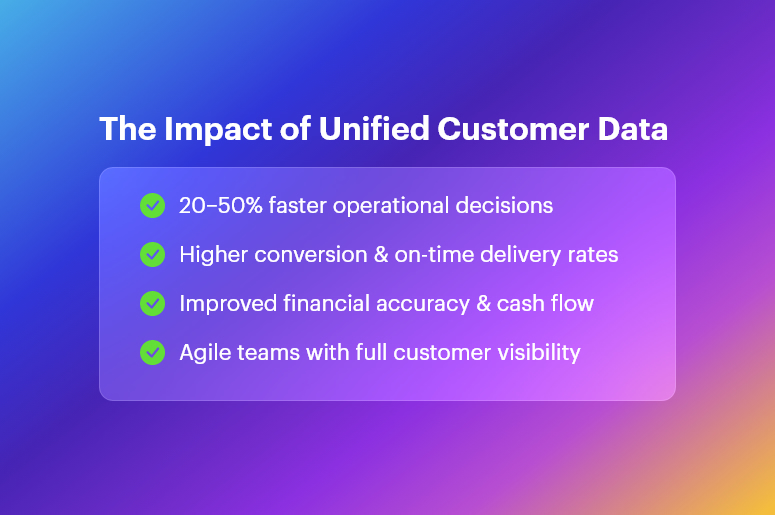
The Impact of Unified Customer Data

How CrmLeaf Centralizes Your Customer Data for Faster Decisions in 2025

A unified system is no longer just an upgrade — it’s a competitive advantage. CrmLeaf is engineered to help growing companies eliminate data silos and support smarter business decisions.

Comprehensive Data Integration

Every customer touchpoint flows automatically into CrmLeaf:

  • Sales quotes and purchase history
  • Accounts receivable and payment records
  • Manufacturing orders and delivery timelines
  • Support tickets and feedback loops

No CSV uploads. Forget duplicated entries. No waiting for “the latest version.”

This instantly improves:

  • Forecast accuracy
  • Sales prioritization
  • Customer satisfaction

Because every team sees the full customer story, not just one piece of it.

Real-Time Dashboards, Analytics & Alerts

CrmLeaf provides live visibility into what’s happening right now:

  • Is stock running low before a big order ships?
  • Are invoices aging past the due date?
  • Are high-value deals stalling in the pipeline?

Custom alerts notify the right people — faster decision → faster resolution → happier customers.

Executives can view KPIs from any device and realign teams instantly.

Cross-Department Collaboration Without Delays

When information flows freely:

  • Sales sees inventory before making promises
  • Finance confirms revenue faster
  • HR manages workforce availability in real time
  • Projects receive accurate resource schedules

Better alignment means:

  • Approvals happen faster
  • Miscommunications disappear
  • Customers receive consistent experiences

Your organization becomes agile, confident, and proactive.

Why Centralization Matters More Than Ever

Today’s businesses battle:

  • Surging customer expectations
  • Supply chain risks
  • Labor constraints
  • Increased regulatory compliance

Disconnected systems create:

  • Reporting delays
  • High error rates
  • Low productivity
  • Loss of revenue

For example:

  • Manufacturers struggle with inaccurate production planning
  • Retailers disappoint customers due to stock mismatches
  • Service businesses miscalculate billable work

Data silos don’t just slow you down — they weaken your reputation. CrmLeaf fixes this structural challenge from the ground up.

Step-by-Step Best Practices for a Successful CrmLeaf Implementation

Even a powerful platform needs a strong rollout strategy. Here’s how to ensure fast adoption and measurable ROI:

Define Clear Business Objectives

Set goals like:

  • Reduce approval time by 40%
  • Increase lead-to-customer conversion by 20%
  • Cut manual data handling in half

When everyone knows the mission, alignment is automatic.

Start Small with High-Impact Quick Wins

Example rollout path:

  • Launch CRM to consolidate contacts and sales processes
  • Add Inventory sync to automate fulfillment
  • Introduce Finance and Payroll for business-wide accuracy

Early successes build trust and momentum.

Implement Strong Data Governance

Create standards for:

  • Field naming
  • Mandatory attributes
  • Duplicate prevention

Assign data champions within each department to maintain integrity long-term.

Take Advantage of Pre-Built Integrations

CrmLeaf connects to:

  • E-commerce platforms
  • Payment gateways
  • Accounting solutions
  • Time tracking & HR systems

This removes manual reconciliation — saving hours every week.

Use an Agile Deployment Framework

Small sprint cycles → constant delivery → lower risk

You see and test progress every two weeks, not at the end.

Prioritize Change Management

People embrace systems that help them work smarter:

  • Show relevance to daily tasks
  • Offer role-based training
  • Provide ongoing help centers & chat support

When adoption is high, ROI skyrockets.

Do’s and Don’ts for Smooth Go-Live

Do Don’t
Prioritize core workflows first Migrate unused reports or fields
Validate permissions and access Give every user unrestricted access
Test integrations early Skip sandbox testing
Embrace mobile access Leave remote users behind

Go-Live Success Checklist

  • Data mapping confirmed
  • Key user approvals done
  • Backup & rollback plan ready
  • Training completed
  • Support channels active

You’re now ready for productivity — Day 1.

Customer Success Example:

Their challenge:

Their CrmLeaf transformation:

  • Real-time inventory sync prevented production stoppages
  • Financial automation improved cash flow
  • Teams accessed accurate material forecasting

Results in 3 months:

  • 45% fewer backorders
  • 60% faster invoicing
  • $150K recovered from overdue payments
  • 20% improvement in delivery performance

This is the power of shared data + smart automation.

Final Takeaways

Centralizing customer data is the foundation for:

  • Faster decisions
  • Streamlined operations
  • Better customer experiences
  • Sustainable growth

CrmLeaf turns scattered systems into a cohesive business engine, enabling every team to operate with clarity and confidence.

When your business moves fast —

  • revenue climbs
  • customers stay loyal
  • competition struggles to keep up

FAQs

What does centralized data mean inside CrmLeaf?

All operational, financial, and customer information updates in real time inside a single platform — no manual sync or duplication.

Can CrmLeaf integrate with my current tools?

Yes — seamless connectors ensure smooth transitions and real-time synchronization.

How long does implementation take?

Typically 8–12 weeks, depending on modules and customization.

How much time can this save my team?

Up to 50% less time spent on manual tracking and reporting.

What makes CrmLeaf secure?

Role-based access, encrypted data, regular audits, and global compliance standards.

How does CrmLeaf improve manufacturing operations?

Precise material planning, automated job costing, and fresh production insights.

What support do we get after onboarding?

Dedicated customer success experts + 24/7 technical assistance.

The Role of Customer Relationship Management in Building High-Performing Sales Teams

According to recent research, companies using a unified CRM + ERP system can boost sales productivity by up to 30%. Yet many small and mid-sized businesses continue to struggle with disconnected tools, manual data entry, and siloed customer insights. The role of customer relationship management in Building High-Performing Sales Teams has never been more critical — especially as we enter a hyper-competitive 2025.

When sales reps lack real-time visibility into inventory, pricing, or customer history, opportunities slip through the cracks and forecasting becomes guesswork.

In this post, you’ll learn:

  • Why a centralized platform is essential
  • Step-by-step best practices to implement
  • Real-world results and success frameworks

By the end, you’ll see how CrmLeaf aligns sales, finance, manufacturing, and HR teams around one single source of truth — driving efficiency, collaboration, and revenue growth.

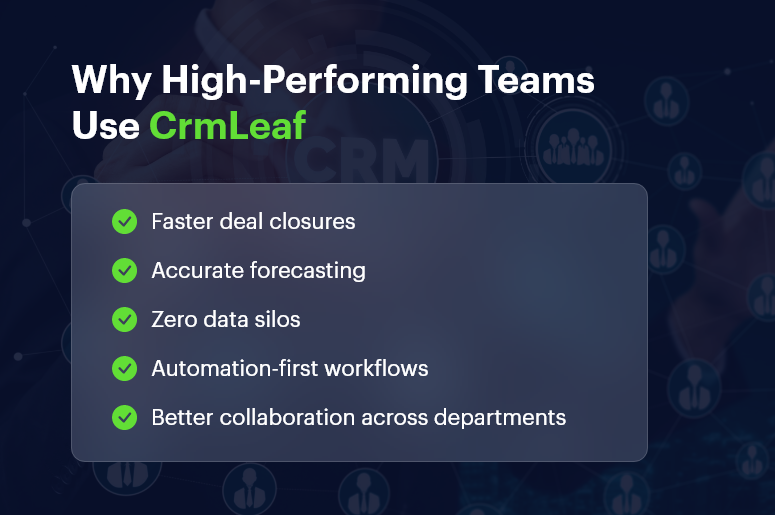
Why High-Performing Teams Use CrmLeaf

Why a Unified Customer Relationship Management Is Essential for Sales Success

In today’s fast-paced sales environment, fragmented systems create unnecessary delays, operational risks, and preventable costs.

Typical challenges include:

  • Data entry errors slowing order fulfillment
  • Missed upsell and cross-sell opportunities due to lack of customer insights
  • High workload and inefficiency as teams switch between outdated tools

Growing businesses need automation, connected workflows, and real-time data to:

  • Eliminate redundancy and manual tasks
  • Improve decision-making with real-time visibility into quotes, inventory, finance, and customer records
  • Standardize processes to prevent compliance risks and operational errors

With CrmLeaf, manufacturing teams access live production and stock data, logistics teams optimize routing, HRMS automates performance-based payroll, and sales reps sell with confidence — powered by one platform.

Best Practices, Frameworks & Actionable Implementation Tips

Follow this structured approach to maximize the role of customer relationship management in building a high-performance sales ecosystem.

1. Establish Clear Objectives

  • Set measurable sales goals (e.g., Increase win rate by 15% in Q2).
  • Map workflows across CrmLeaf modules to identify bottlenecks.

2. Standardize Data & Processes

  • Use uniform data fields and validation to prevent duplicates.
  • Integrate HRMS and Payroll to automate commission tracking.

3. Automate Routine Tasks

  • Use CrmLeaf’s workflow engine to auto-assign leads by territory or product.
  • Create reusable email templates and smart follow-up sequences.

4. Align Teams with Dashboards & KPIs

  • Build dashboards combining customer relationship management, Finance, Inventory, and Manufacturing insights.
  • Use alerts for critical triggers — overdue quotes, low stock, or stalled deals.

5. Train Continuously

  • Host monthly sessions using CrmLeaf Academy.
  • Enable mobile access so reps stay productive from anywhere.

Do’s & Don’ts

Do:

  • Engage finance, sales & operations early
  • Use phased rollouts and pilot groups

Don’t:

  • Over-automate without governance
  • Skip change management and training

Quick Wins Checklist

  • Enable lead scoring
  • Integrate email client for automatic logging
  • Set up approval workflows for quotes and contracts

Common Mistakes to Avoid

  • Migrating without cleansing legacy data
  • Treating customer relationship management adoption as an “IT project”
  • Ignoring mobile optimization

Expert Recommendations

  • Audit tech stack quarterly
  • Use API integrations for marketing, payments & automation
  • Track both leading and lagging KPIs

Why a Unified CRM + ERP Delivers Superior Results

CrmLeaf provides:

  • End-to-end visibility across modules
  • Real-time synchronization to prevent errors
  • Modular expansion as business scales

This unified architecture eliminates silos and supports continuous growth — without complexity.

Customer Success Story

Apex Manufacturing implemented CrmLeaf’s Lead-to-Cash automation to eliminate manual workflows and outdated spreadsheets.

In just 90 days, they achieved:

  • 25% reduction in order processing time
  • 15% increase in upsell revenue
  • 80% decrease in data reconciliation errors

Key improvements included:

  • Real-time stock visibility for reps
  • Automated commission updates via Payroll
  • Faster month-end closing cycles for finance

Key Takeaways

Building a high-performing sales team in 2025 requires more than a standalone customer relationship management — it demands a unified CRM + ERP platform.

With CrmLeaf, businesses can:

  • Standardize workflows
  • Automate tasks
  • Align teams around reliable real-time data

The Role of customer relationship management in Building High-Performing Sales Teams is clear: empower reps with insights, automate complexity, and scale intelligently.

Using Lead Scoring to Prioritize Almost-Close Deals

Not every lead deserves the same level of attention. Your marketing campaigns may generate hundreds of leads — but only a handful are truly ready to buy. The rest are just browsing, comparing, or not yet convinced.

This is where Lead Scoring comes in. It’s the process of assigning a numerical value (score) to each lead based on their behavior, engagement, and fit. This helps your sales team instantly identify which leads are closest to closing, and where to focus their time and energy for maximum ROI.

With a powerful CRM like CrmLeaf, lead scoring becomes your sales team’s radar for deal readiness — cutting through the noise to spotlight the deals that matter most.

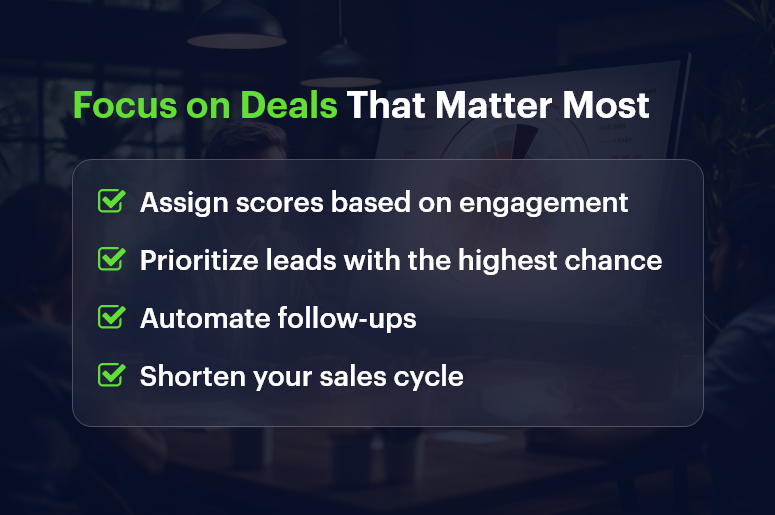
Focus on Deals That Matter Most

What Is Lead Scoring?

Lead scoring is a structured method of ranking leads based on how likely they are to become customers. Each lead gets a score — usually on a scale from 0 to 100 — calculated by evaluating:

  • Demographics: Who they are (industry, job title, company size)
  • Behavioral Data: What they do (website visits, email opens, form submissions, demo requests)
  • Engagement Level: How often they interact with your brand
  • Buying Intent: Signals like product inquiries or pricing page visits

The higher the score, the more sales-ready the lead is.

Why Lead Scoring Matters

Without lead scoring, your sales reps spend hours calling the wrong prospects — wasting time, money, and momentum.

Here’s why smart businesses use lead scoring to drive faster conversions:

  1. Prioritize the Hottest Leads
    Sales teams instantly see which leads are ready to buy.
  2. Improve Conversion Rates
    Focusing on qualified, high-scoring leads boosts your close ratio.
  3. Align Marketing & Sales Teams
    Both teams agree on what qualifies as a “good lead.”
  4. Shorten the Sales Cycle
    High-intent leads move faster when engaged at the right time.
  5. Increase ROI
    Better targeting means fewer wasted calls, ads, and emails.

How Lead Scoring Works in a CRM

A modern CRM like CrmLeaf automates lead scoring using custom rules and AI insights.

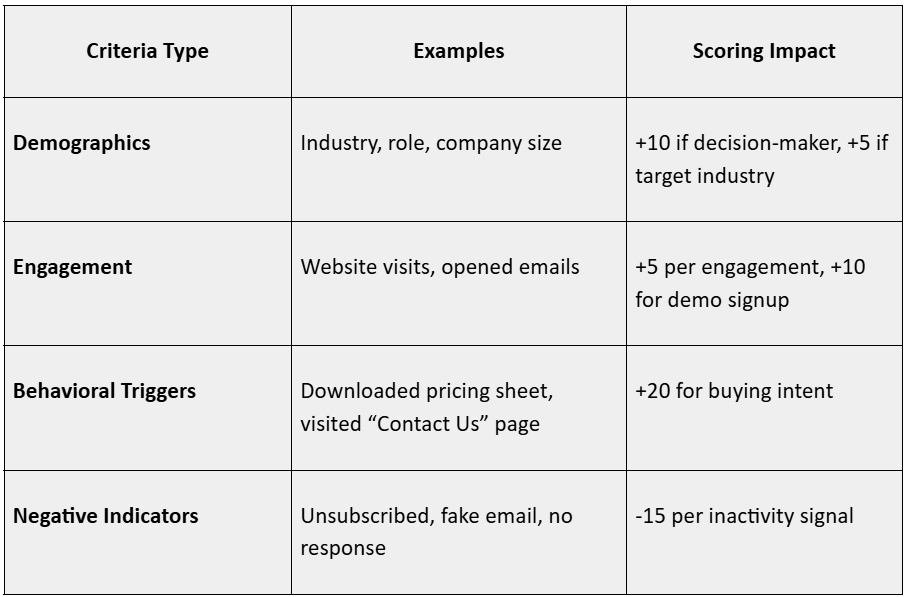
Here’s how it typically works:

Lead Scoring

Once the CRM collects and calculates these factors, each lead gets an automated score.

Sales reps can then filter, segment, and prioritize “hot leads” (e.g., score ≥70) and move them quickly through the funnel.

Identifying “Almost-Close” Deals

So what exactly is an almost-close deal?

These are the leads who’ve shown multiple buying signals, such as:

  • Requested a product demo or pricing
  • Engaged with multiple follow-up emails
  • Added items to cart (for eCommerce CRMs)
  • Discussed budget or timeline
  • Clicked on high-intent pages (like “Plans” or “Integrations”)

Their lead score often sits between 70–90 — meaning they’re sales-qualified (SQLs) but just need a final nudge to convert.

How to Prioritize Almost-Close Deals Using Lead Scoring

1. Set Clear Scoring Rules

Customize your CRM’s lead scoring model to reflect your business’s buying signals.
For example:

  • +20 points for “Request a Demo”
  • +15 points for “Visited Pricing Page”
  • +10 points for “Opened Follow-Up Email”
  • -10 points for “No Activity for 10 Days”

2. Use AI-Powered Predictions

Advanced CRMs like CrmLeaf use AI to predict deal closure probability based on past patterns. The system identifies leads that resemble your highest-value customers and flags them automatically.

3. Create a Priority Dashboard

Group your leads into segments like:

  • Hot Leads (Score 80–100) — Immediate follow-up
  • Warm Leads (Score 50–79) — Nurture with personalized emails
  • Cold Leads (Score <50) — Continue automated marketing campaigns

4. Automate Follow-Ups

Trigger automated workflows:

  • Send a personalized message when a lead score crosses 70.
  • Assign the lead to a senior rep.
  • Schedule a reminder call or demo invite.

Automation ensures you never miss a critical follow-up window.

5. Use Negative Scoring

Subtract points for:

  • Bounced emails
  • Long inactivity
  • Unsubscribed contacts

This keeps your lead database clean and realistic.

6. Re-Engage Stalled Deals

Leads close to conversion may go silent for a while. Use CRM insights to:

  • Send a “We Miss You” email
  • Offer a limited-time discount
  • Share a case study or testimonial

Small nudges often reopen big opportunities.

Example: How CrmLeaf Streamlines Lead Scoring

Here’s how a sales workflow looks with CrmLeaf’s Lead Scoring Engine:

  • Lead enters from a Facebook Ad or Landing Page.
  • CRM automatically assigns points for source, activity, and location.
  • Once the score crosses 70, the lead moves to the “Hot” pipeline.
  • CRM sends a real-time alert to the assigned sales rep.
  • Rep follows up within minutes — while the lead’s still engaged.
  • The dashboard updates conversion probability and next best action.

Result? Faster decisions, shorter sales cycles, and higher win rates.

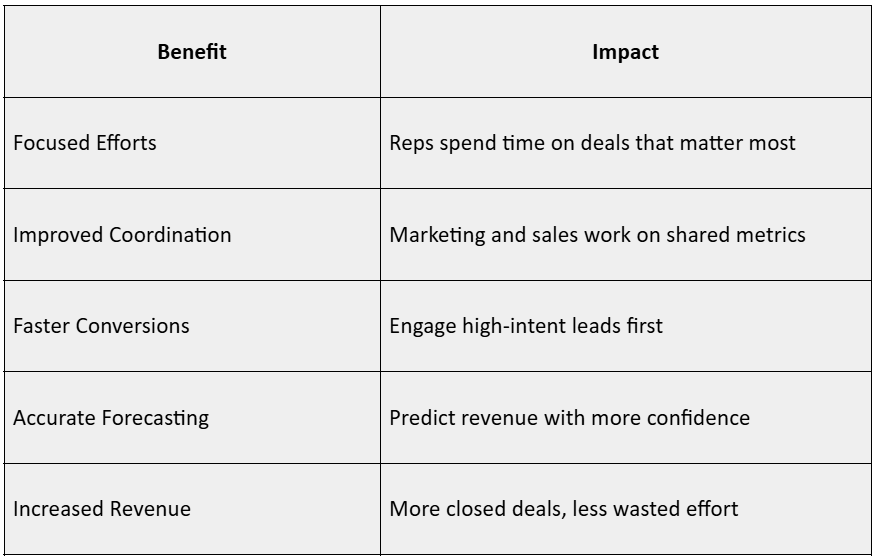
Benefits of Using Lead Scoring for Sales Teams

Benefits-Of-Lead-Scoring

Common Mistakes to Avoid

1. Using a One-Size-Fits-All Model
Every business has unique triggers. Customize your scoring rules.

2. Ignoring Negative Scores
Penalize inactivity or disinterest to keep lead data accurate.

3. Failing to Review Regularly
Update your model quarterly based on performance metrics.

4. Not Aligning with Sales Teams
Ensure both marketing and sales agree on what “ready to close” means.

5. Neglecting Lead Nurturing
Not all low-scoring leads are lost — nurture them for future sales.

The Future of Lead Scoring: From Manual to Predictive

Today’s CRMs are evolving from static scoring rules to AI-powered predictive scoring. These systems analyze patterns across thousands of data points — including behavior, demographics, and conversion history — to automatically identify the next best lead to pursue.

Platforms like CrmLeaf use this intelligence to:

  • Recommend which leads are “almost close.”
  • Suggest personalized outreach tactics.
  • Continuously learn from past deal outcomes.

The result? A self-optimizing sales funnel that gets smarter with every interaction.

Conclusion: Focus on What Matters Most — Closing Deals

Lead scoring isn’t just a sales hack — it’s a strategic framework that lets your team focus on what truly drives growth.

By prioritizing almost-close deals, you improve efficiency, speed up conversions, and ensure no high-value opportunity slips through the cracks.

With CrmLeaf’s AI-driven Lead Scoring, your sales team doesn’t just work harder — they work smarter, turning every lead into a measurable win.

FAQs

1. What is lead scoring in CRM?
It is assigning numerical values to leads based on engagement, fit, and buying intent.

2. How does lead scoring help sales teams?
It helps prioritize the most sales-ready leads and close deals faster.

3. What’s a good lead score range?
Typically, 70–100 indicates a hot, almost-close lead.

4. Can lead scoring be automated?
Yes — most modern CRMs automate scoring and update it in real time.

5. What data sources are used for scoring?
Website activity, email engagement, demographic info, and past purchases.

6. What is negative lead scoring?
Deducting points for disinterest, inactivity, or unqualified data.

7. How often should I update my lead scoring model?
Review and adjust quarterly or after major campaign changes.

8. What’s the difference between MQL and SQL?
MQLs are marketing-qualified leads; SQLs are sales-ready, high-scoring leads.

9. Can AI improve lead scoring accuracy?
Absolutely. AI identifies subtle patterns and predicts conversion likelihood more precisely.

10. What’s the ROI of using lead scoring?
Businesses see up to 35–50% faster conversions and better resource allocation.